A critique paper is an academic writing genre that summarizes and gives a critical evaluation of a concept or work. Or, to put it simply, it is no more than a summary and a critical analysis of a specific issue. This type of writing aims to evaluate the impact of the given work or concept in its field.
Want to learn more? Continue reading this article written by Custom-writing experts! It contains:
- best tips on how to critique an article or a literary work,
- a critique paper example with introduction, body, and conclusion.
💁 What Is a Critique Paper?
A critique is a particular academic writing genre that requires you to carefully study, summarize, and critically analyze a study or a concept. In other words, it is nothing more than a critical analysis. That is all you are doing when writing a critical essay: trying to understand the work and present an evaluation. Critical essays can be either positive or negative, as the work deserves.
👣 How to Write a Critique Essay: Main Steps
Starting critique essays is the most challenging part. You are supposed to substantiate your opinion with quotes and paraphrases, avoiding retelling the entire text. A critical analysis aims to find out whether an article or another piece of writing is compelling. First, you need to formulate the author’s thesis: what was the literary work supposed to convey? Then, explore the text on how this main idea was elaborated. Finally, draft your critique according to the structure given below.
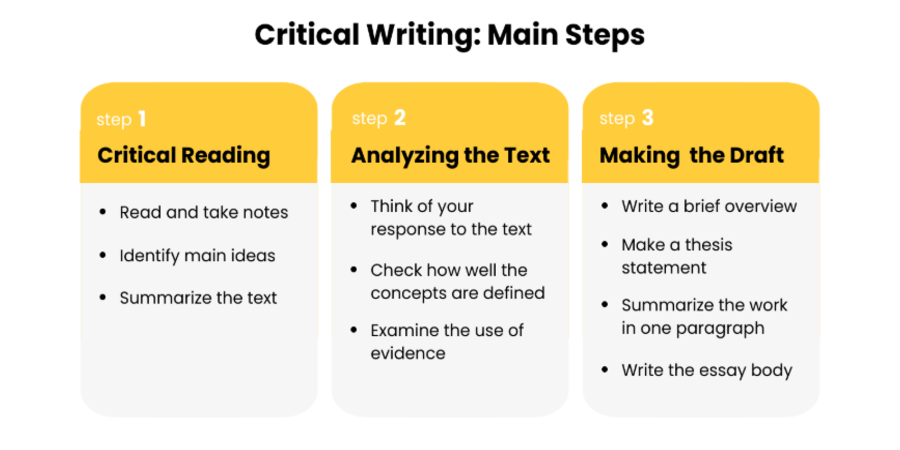
Step 1: Critical Reading
1.1. Attentively read the literary work. While reading, make notes and underline the essentials.
- Try to come into the author’s world and think why they wrote such a piece.
- Point out which literary devices are successful. Some research in literary theory may be required.
- Find out what you dislike about the text, i.e., controversies, gaps, inconsistency, or incompleteness.
1.2. Find or formulate the author’s thesis.
- What is the principal argument? In an article, it can be found in the first paragraph.
- In a literary work, formulate one of the principal themes, as the thesis is not explicit.
- If you write a critique of painting, find out what feelings, emotions, or ideas, the artist attempted to project.
1.3. Make a summary or synopsis of the analyzed text.
- One paragraph will suffice. You can use it in your critique essay, if necessary.
- The point is to explore the gist.
Step 2: Analyzing the Text
After the reading phase, ask yourself the following questions:
- What was your emotional response to the text? Which techniques, images, or ideas made you feel so?
- Find out the author’s background. Which experiences made them raise such a thesis? What other significant works have they written that demonstrate the general direction of thought of this person?
- Are the concepts used correctly in the text? Are the references reliable, and do they sufficiently substantiate the author’s opinion?
Step 3: Drafting the Essay
Finally, it is time to draft your essay. First of all, you’ll need to write a brief overview of the text you’re analyzing. Then, formulate a thesis statement – one sentence that will contain your opinion of the work under scrutiny. After that, make a one-paragraph summary of the text.
You can use this simple template for the draft version of your analysis. Another thing that can help you at this step is a summary creator to make the creative process more efficient.
Critique Paper Template
Example:
- Introduction. Paragraph 1.
- Start with an introductory phrase about the domain of the work in question.
- Tell which work you are going to analyze, its author, and year of publication.
- Specify the principal argument of the work under study.
- In the third sentence, clearly state your thesis.
- Summary. Paragraph 2.
- Here you can insert the summary you wrote before.
- This is the only place where you can use it. No summary can be written in the main body!
- Main Body. Paragraph 3-5 (or more).
- Use one paragraph for every separate analyzed aspect of the text (style, organization, fairness/bias, etc.).
- Each paragraph should confirm your thesis (e.g., whether the text is effective or ineffective).
- Each paragraph shall start with a topic sentence, followed by evidence, and concluded with a statement referring to the thesis.
- Conclusion. The last paragraph.
- Provide a final judgment on the effectiveness of the piece of writing.
- Summarize your main points and restate the thesis, indicating that everything you said above confirms it.
👀 Critical Essay Types
You can evaluate the chosen work or concept in several ways. Pick the one you feel more comfortable with from the following:
- Descriptive critical essays examine texts or other works. Their primary focus is usually on certain features of a work, and it is common to compare and contrast the subject of your analysis to a classic example of the genre to which it belongs.
- Evaluative critical essays provide an estimate of the value of the work. Was it as good as you expected based on the recommendations, or do you feel your time would have been better spent on something else?
- Interpretive essays provide your readers with answers that relate to the meaning of the work in question. To do this, you must select a method of determining the meaning, read/watch/observe your analysis subject using this method, and put forth an argument.
There are also different types of critiques. The University of North Carolina-Chapel Hill, in the article “Writing critiques,” discusses them as well as the appropriate critique language.
Critique Paper Topics
- Critique of the article Is Google Making Us Stupid? by Nicholas Carr.
- Interpret the symbolism of Edgar Alan Poe’s The Black Cat.
- Examine the topicality of the article Impact of Racial/Ethnic Differences on Child Mental Health Care.
- Critical essay on Alice Walker’s short story Everyday Use.
- Discuss the value of the essay The Hanging by George Orwell.
- A critique on the article Stocks Versus Bonds: Explaining the Equity Risk Premium.
- Explore the themes Tennessee Williams reveals in The Glass Menagerie.
- Analyze the relevance of the article Leadership Characteristics and Digital Transformation.
- Critical evaluation of Jonathan Harvey’s play Beautiful Thing.
- Analyze and critique Derek Raymond’s story He Died with His Eyes Open.
- Discuss the techniques author uses to present the problem of choice in The Plague.
- Examine and evaluate the research article Using Evidence-Based Practice to Prevent Ventilator-Associated Pneumonia.
- Explore the scientific value of the article Our Future: A Lancet Commission on Adolescent Health and Wellbeing.
- Describe the ideas E. Hemingway put into his A Clean, Well-Lighted Place.
- Analyze the literary qualities of Always Running La Vida Loca: Gang Days in L. A.
- Critical writing on The Incarnation of Power by Wright Mills.
- Explain the strengths and shortcomings of Tim Kreider’s article The Busy Trap.
- Critical response to Woolf’s novel Mrs. Dalloway.
- Examine the main idea of Richard Godbeer’s book Escaping Salem.
- The strong and weak points of the article The Confusion of Tongues by William G. Bellshaw.
- Critical review of Gulliver’s Travels.
- Analyze the stylistic devices Anthony Lewis uses in Gideon’s Trumpet.
- Examine the techniques Elie Wiesel uses to show relationship transformation in the book Night.
- Critique of the play Fences by August Wilson.
- The role of exposition in Achebe’s novel Things Fall Apart.
- The main themes John Maxwell discusses in his book Disgrace.
- Critical evaluation of Ray Bradbury’s Fahrenheit 451.
- The ideas and concept of the book The Vegetarian Imperative.
- Different points of view on one historical figure in the book Two Lives of Charlemagne.
📝 Critique Paper Format
Since the APA critique paper format is one of the most common, let’s discuss it in more detail. Check out the information below to learn more:
📌 Font
The APA Manual recommends using the following fonts:
- 11-point Calibri,
- 11-point Arial,
- 10-point Lucida Sans Unicode,
- 12-point Times New Roman,
- 11-point Georgia,
- 10-point Computer Modern.
📌 Margins
Add 1-inch margins on all sides.
📌 Page numbers
Page numbers should appear at the top right-hand corner, starting with the title page.
📌 Line spacing
The entire document, including the title page and reference list, should be double-spaced.
📌 Title page
The title page should include the following information:
- page number 1 in the top right-hand corner of the page header,
- paper title,
- the student’s name,
- the name of the department and the college or university,
- course number and name,
- the instructor’s name,
- due date (the date format used in your country).
📌 Critique paper title
The title of your critique paper should be no more than 12 words. In addition, it should be centered and typed in bold using title case.
📌 In-text citations
For the in-text citation, provide the author’s last name and publication year in brackets. If you are using direct citation, add the page number after the year.
📌 References
The last page of your paper should include a list of all sources cited in your essay. Here’s a general format of book and journal article citations you should use:
Book: Last name, First initial. Middle initial. (Year). Book title: Subtitle. Publisher.
Journal article: Last name, First initial. Middle initial. (Year). Title of the article. Journal Title, volume (issue number), start page–end page.
📑 Critique Paper Outline
The main parts of good critical response essays are:
- Introduction. The introduction is the most essential part of the critical response. It should be concise and include the author and title of the work being analyzed, its main idea, and a strong thesis statement.
- Summary. This should be brief and to the point. Only the author’s/creator’s main ideas and arguments should be included.
- Analysis/interpretation. Discuss what the author’s/creator’s primary goal was and determine whether this goal was reached successfully. Use the evidence you have gathered to argue whether or not the author/creator achieved was adequately convincing (remember there should be no personal bias in this discussion).
- Evaluation/response. At this point, your readers are ready to learn your objective response to the work. It should be professional yet entertaining to read. Do not hesitate to use strong language. You can say that the work you analyzed was weak and poorly-structured if that is the case, but keep in mind that you have to have evidence to back up your claim.
- Conclusion. The last paragraph of your work should restate the thesis statement, summarize the key points, and create a sense of closure for the readers.
Critique Paper Introduction
The introduction is setting the stage for your analysis. Here are some tips to follow when working on it:
- Provide the reader with a brief synopsis of the main points of the work you are critiquing.
- State your general opinion of the work, using it as your thesis statement. The ideal situation is that you identify and use a controversial thesis.
- Remember that you will uncover a lot of necessary information about the work you are critiquing. You mustn’t make use of all of it, providing the reader with information that is unnecessary in your critique. If you are writing about Shakespeare, you don’t have to waste your or your reader’s time going through all of his works.
Critique Paper Body
The body of the critique contains the supporting paragraphs. This is where you will provide the facts that prove your main idea and support your thesis. Follow the tips below when writing the body of your critique.
- Every paragraph must focus on a precise concept from the paper under your scrutiny, and your job is to include arguments to support or disprove that concept. Concrete evidence is required.
- A critical essay is written in the third-person and ensures the reader is presented with an objective analysis.
- Discuss whether the author was able to achieve their goals and adequately get their point across.
- It is important not to confuse facts and opinions. An opinion is a personal thought and requires confirmation, whereas a fact is supported by reliable data and requires no further proof. Do not back up one idea with another one.
- Remember that your purpose is to provide the reader with an understanding of a particular piece of literature or other work from your perspective. Be as specific as possible.
Critique Paper Conclusion
Finally, you will need to write a conclusion for your critique. The conclusion reasserts your overall general opinion of the ideas presented in the text and ensures there is no doubt in the reader’s mind about what you believe and why. Follow these tips when writing your conclusion:
- Summarize the analysis you provided in the body of the critique.
- Summarize the primary reasons why you made your analysis.
- Where appropriate, provide recommendations on how the work you critiqued can be improved.
For more details on how to write a critique, check out the great critique analysis template provided by Thompson Rivers University.
If you want more information on essay writing in general, look at the Secrets of Essay Writing.
Example of Critique Paper with Introduction, Body, and Conclusion
Check out this critical response example to “The Last Inch” by James Aldridge to show how everything works in practice:
Example:
Introduction
In his story “The Last Inch,” James Aldridge addresses the issue of the relationship between parents and children. The author captured the young boy’s coming into maturity coinciding with a challenging trial. He also demonstrated how the twelve-year-old boy obtained his father’s character traits. Aldridge’s prose is both brutal and poetic, expressing his characters’ genuine emotions and the sad truths of their situations.
Body: Summary
The story is about Ben Ensley, an unemployed professional pilot, who decides to capture underwater shots for money. He travels to Shark Bay with his son, Davy. Ben is severely injured after being attacked by a shark while photographing. His last hope of survival is to fly back to the little African hamlet from where they took off.
Body: Analysis
The story effectively uses the themes of survival and fatherhood and has an intriguing and captivating plot. In addition, Ben’s metamorphosis from a failing pilot to a determined survivor is effectively presented. His bond with his son, Davy, adds depth and emotional importance to the story. At the same time, the background information about Ben’s past and his life before the shark attack could be more effectively integrated into the main story rather than being presented as separate blocks of text.
Body: Evaluation
I find “The Last Inch” by James Aldridge a very engaging and emotional story since it highlights the idea of a father’s unconditional love and determination in the face of adversity. I was also impressed by the vivid descriptions and strong character development of the father and son.
Conclusion
“The Last Inch” by James Aldridge is an engaging and emotional narrative that will appeal to readers of all ages. It is a story of strength, dedication, and the unbreakable link between father and son. Though some backstory could be integrated more smoothly, “The Last Inch” impresses with its emotional punch. It leaves the readers touched by the raw power of fatherly love and human will.
📚 Critique Essay Examples
With all of the information and tips provided above, your way will become clearer when you have a solid example of a critique essay.
Below is a critical response to The Yellow Wallpaper by Charlotte Perkins Gilman.
Example:
When speaking of feminist literature that is prominent and manages to touch on incredibly controversial issues, The Yellow Wallpaper is the first book that comes to mind. Written from a first-person perspective, magnifying the effect of the narrative, the short story by Charlotte Perkins Gilman introduces the reader to the problem of the physical and mental health of the women of the 19th century. However, the message that is intended to concern feminist ideas is rather subtle. Written in the form of several diary entries, the novel offers a mysterious plot, and at the same time, shockingly realistic details.
What really stands out about the novel is the fact that the reader is never really sure how much of the story takes place in reality and how much of it happens in the psychotic mind of the protagonist. In addition, the novel contains a plethora of description that contributes to the strain and enhances the correlation between the atmosphere and the protagonist’s fears: “The color is repellent, almost revolting; a smoldering unclean yellow, strangely faded by the slow-turning sunlight” (Gilman).
Despite Gilman’s obvious intent to make the novel a feminist story with a dash of thriller thrown in, the result is instead a thriller with a dash of feminism, as Allen (2009) explains. However, there is no doubt that the novel is a renowned classic. Offering a perfect portrayal of the 19th-century stereotypes, it is a treasure that is certainly worth the read.
If you need another critique essay example, take a look at our sample on “The Importance of Being Earnest” by Oscar Wilde.
And here are some more critique paper examples for you check out:
- A Good Man Is Hard to Find: Critique Paper
- Critique on “The Yellow Wallpaper” by Charlotte Perkins Gilman
- “When the Five Rights Go Wrong” Article Critique
- Homer’s Iliad and Odyssey — Comparison & Critique
- Benefits and Disadvantages of Prone Positioning in Severe Acute Respiratory Distress: Article Critique
- Reducing Stress in Student Nurses: Article Critique
- Management of Change and Professional Safety – Article Critique
- “Views of Young People Towards Physical Activity”: Article Critique
Seeing an example of a critique is so helpful. You can find many other examples of a critique paper at the University of Minnesota and John Hopkins University. Plus, you can check out this video for a great explanation of how to write a critique.



![Short Story Analysis: How to Write It Step by Step [New]](https://custom-writing.org/blog/wp-content/uploads/2020/12/man-sits-end-trolltunga-before-mountains-284x153.jpg)

![Common Essay Mistakes—Writing Errors to Avoid [Updated]](https://custom-writing.org/blog/wp-content/uploads/2020/12/avoid-mistakes-ccw-284x153.jpg)

![Why I Want to Be a Teacher Essay: Writing Guide [2026]](https://custom-writing.org/blog/wp-content/uploads/2020/12/senior-male-professor-writing-blackboard-with-chalk3-284x153.jpg)
![Friendship Essay: Writing Guide & Topics on Friendship [New]](https://custom-writing.org/blog/wp-content/uploads/2020/12/smiley-female-friends-fist-bumping-284x153.jpg)



May I know who’s the author? For my citation activity.
Hello, Kriszha! You can reference it as a web source/web page.
Wow…great work… kindly can you assist me in writing a critique about indiscipline in a school
That’s an interesting demonstration I watched. However, my weakness is that I’m very poor in language and analysing issues.
Hi, can you help me for my assignment about article critiquing?
I need your help if you can send me a full written dissertation..thank you
This is gud
Can you help me to my activities
Thank you so much! This really helped me!