Report writing tips for students can save time and help organize ideas. Besides, they often explain how to edit and proofread effectively to avoid the most common mistakes.
Some of the most universal report writing tips include:
- Considering the purpose of the report
- Reading the report writing guidelines carefully
- Planning before you write
- Conducting thorough research
- Proofreading
Do you need more specific advice on report writing for students? Keep reading our article! Here, our Custom-Writing.org specialists will present the report definition, talk about its structure, and clarify the main report writing rules depending on the type.
While having a step-by-step guide can be enough for some students, others might need additional help with their reports. This task can be incredibly challenging for those who lack relevant writing experience. Preparing a report for the first time may present difficulties, as you must use specialized jargon while remaining clear and understandable. If you’re searching for assistance with your lab report, consider using Custom Writing! Our Master’s and PhD-level experts are here to help you present your research findings in a compelling and professional way.
📋 What Is a Report?
A report is a way to communicate data that you have collected and analyzed so that the intended audience can understand the information concerning a specific issue or problem. Reports always follow a clear and defined structure. It includes sections and subsections and allows the information to be organized logically.
But that’s not all:
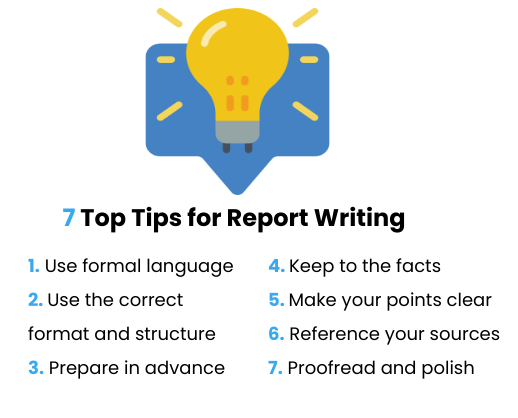
There are several essential report writing tips you have to learn as a student:
- Use formal language. A report is an analysis or a description based on research. Therefore, a writer has to use formal language. It requires passive voice use, little to no personal pronouns, neutral verbs.
- Ensure the correct format. For the readers to clearly understand the report, a specific format should be followed. All sections should be in plain English. The body might be written using jargon or specific terminology.
- Prepare in advance. Before starting to write the report, identify the audience and its purpose. Once you do that, collect and outline the information. With the proper organization, the writing part will be easier to conduct.
- Keep to the facts. Focus your writings on the facts. Seek relevant and appropriate information for your report. Find credible sources and provide evidence and illustrative examples based on the information found.
- Make your points clear. Write clearly and concisely. Make sure to write short and simple sentences in plain English. Use linking words and active voice. Also, don’t forget about the punctuation.
- Reference your sources. Referring to someone’s idea in your report, make sure to reference it in the text. After you do that, don’t forget to check whether the sources are correctly referenced. Also, see whether in-text citations match the reference list.
- Proofread and polish your report. After finishing your work, check grammar and punctuation and shorten the sentences. Try to think about the information you want to convey in your report. Succinct writing will help you elaborate on the topic more effectively. However, try not to be too brief, as you might miss the necessary data.
Revising your work is vital. Here are the things you need to check after finishing writing:- The guidelines. Did you do what you’ve been asked to?
- The structure. Make sure that the required sections of the report are present.
- The information. No gaps in the literature should be present.
- The argument. The information should support the point.
- The terminology. Explain every unknown word and phrase.
- The formatting. Font, headings, and numbers should be consistent throughout the text.
- The effectiveness. The report should be easy to read and effectively convey the info.
🧩 Academic Report Structure
There are many different types of academic reports that depend on the various disciplines for which they are written. Yet, each one relies on a similar structure, which is a minimum requirement.
Let’s take a look at report writing structure:
- Overview: This is where you will write a summary of the whole report informing the reader what is covered. At the very least, this summary will introduce the purpose and the primary features. You might also mention any conclusions reached and offer up recommendations.
- Background: This is the section in which you provide the purpose of the report in greater detail. The background information for the text is also introduced here. This background addresses the 5 Ws: Who, What, Where, When, and Why.
- Discussion: This is where you present your results and findings. You will include all your evidence, data, findings, and arguments in this section. It must be well-organized. Use headings and subheadings to ensure your information makes sense to the reader.
- Conclusion: This is where you review the primary points from the discussion and state all conclusions to which you have arrived. You should first discuss the main result, followed by the remaining findings, present logically. You can also provide recommendations if it’s relevant to your report.
Each of these must be present in a general report structure and format. However, specialized types of report writing might call these sections by different names. They might include additional parts to help deliver the required information.
At the very least, you should generally include a title page, a table of contents, and appendices. The University of Leicester provides excellent examples of a report writing format.
🔬 Report Writing Tips According to Type
Let’s take a look at some specific and common types of reports that you might be asked to write with that in mind.
But remember:
Regardless of whether you see a specific format for report writing here or elsewhere, you have to ensure that it fits with the type you are required to write.
To make sure this is the case, here are some helpful tips for report writing:
- Read all formatting guidelines carefully. Pay close attention to the language used in report writing guidelines. It is rare for an official website to use colloquialisms, so they might not be reliable if you see them.
- Make sure the guidelines are suitable. Some can be unfitting for the type of report you will be writing. Since there are many types, there is a good chance that the guidelines you have come across are for a different kind of report.
- Do not carelessly follow any guidelines. Even if the guidelines for writing a report essay are written according to high standards, it does not mean that you need to include all sections recommended in the guidelines. Only add the parts that are relevant to your report and modify them if necessary.
The academic writing format varies with the type of report. Therefore, it’s time to start learning about the most popular ones.
Financial Report Tips
A financial report is a type of business report writing, and its structure is very similar to the organization provided above. If you are a student of business, then you need to learn how to write them.
What should be included in a financial report?
- External financial statements. These include income statements, comprehensive income statements, balance sheets, statements of cash flow, and statements of stockholders’ equity.
- Notes to financial statements.
- Communication concerning quarterly profit and related data through press releases and conference calls.
- Quarterly and annual reports to stockholders.
- Information about finances posted on the business’ website.
- Financial reports to legislative offices, including quarterly and annual reports to the Securities and Exchange Commission (SEC).
- Documentation relating to the issuance of common stock and various securities.
A financial statement consists of several elements. Two elements are essential: the balance sheet and the income statement. Additionally, cash flow statements and notes to financial statements are prepared.
The main elements of a financial report are as follows:
- Title Page. The part includes the title of your report, your name, and the date of submission.
- Executive Summary. It is essentially the Overview discussed above, with which you present a summary of the entire report, including the methods of analysis used, findings, and recommendations.
- Table of Contents. Here you provide a thorough list of the sections and subsections in the report.
- Introduction. It is the equivalent of the Background discussed in the general structure. You should include an outline of the report and any relevant background information and terms of reference the reader needs.
- Body. It is the equivalent of the Discussion presented above. You should divide the discussion of the data and findings into organized sections and subsections.
- Conclusion. As discussed above, here you will summarize the report’s main points, the findings, the conclusions drawn, and any recommendations, if relevant.
You can refer to the University of Wollongong for detailed information on how to write a financial report.
Lab Report Tips
The time will come when you have to present your lab results in the form of a formatted laboratory report. This is where you might be wondering how to write one. Relax. It’s easier than you think.
A lab report is a scientific paper that summarizes the goal of the lab you conducted, including your methods and findings. Its purpose is to demonstrate to your instructor that you understood the lab and adequately present your findings.
A lab report generally consists of seven primary sections, as follows:
- Title Page. The part is where you will include the title of your experiment, your name (and the names of other group members), the course’s name, your instructor’s name, and the date of the experiment. The title page of the scientific report should indicate what the experiment is about. The variables of the study should be there.
- Abstract. The abstract summarizes the report shortly and concisely. The abstract should aim to address the following briefly:
- The point and reasoning to the examination within one/two sentences.
- The participants and setting.
- The technique: what design, what surveys or questionnaires were used?
- The significant findings. You can mention specific statistical findings or simply summarize the results.
- How does the study contribute to the knowledge within the literature? What was the research done for?
- Introduction. It is a summary of the experiment and why you are conducting it. You should include any research questions or hypotheses addressed in the investigation. Remember that you only need to use one of them.
The introduction should present general information about the topic. Ideally, the writer should start broad and then narrow down to a specific point. That way, the study’s aim does not appear out of thin air but has a theoretical background.
A research question example:
Can background rock music improve students’ math performance?
The equivalent research hypothesis example:
Background rock music can have a positive impact on students’ math performance.
Keep in mind:
The question allows for both a positive and a negative answer, while the hypothesis gives a specific direction. - Methods and Materials. It is here that you present the methods and materials you used in the experiment. You must explain why you have chosen them using appropriate terminology.
In the Method section, you should use these subheadings:- Participants. Provide information on how many participants were recruited and how you obtained the sample. Add any necessary and relevant demographic data.
- Design. State the experimental design. Provide the information on the variables, how were they operationalized, and what controls were used?
- Materials. Provide the list of the materials used. Include the reliability of the measures used in the study.
- Procedure. Describe the exact process briefly but in sufficient detail to allow the replication of the studies.
- Results. Briefly state what you found when conducting your experiment. You can use several methods to display your data, including use tables and graphs, to ensure your results are easy to understand.
Present the descriptive statistics followed by inferential. Name the statistical test. Report the means, standard deviations, confidence intervals, and any other appropriate statistics. The effect size is optional to be reported. - Discussion. It is the most significant section of your lab report, which means it will be the longest. Here, you will discuss the critical analysis of your findings and provide an interpretation of them. Make sure to write the discussion in plain English, avoiding statistical terminology.
Compare the results of the present study to the ones used in the Introduction section. Discuss the similarities/differences. Be sure to link this discussion to your original research question or hypothesis and discuss your methods’ potential limitations. Upon that, discuss constructive ways your study could be improved. In case there were incidents in your research, mention them. Provide an idea for future research. - Conclusion. Briefly summarize the experiment or lab you conducted and the results. It is not a section to include new information. Summarize the key points and findings in no more than 3-4 sentences.
- References. Consult the required citation style guidelines, and be sure to include all your sources in this section. Find out more about format styles and APA citation style in particular.
Remember that it is not a bibliography. Every time you refer to an idea or a name, you need to cite the information source.
Naturally, you might be writing lab reports in many sciences, such as physics, biology, chemistry, and geology. However, they, along with technical report writing, tend to follow the same format.
Here is a lab report example for students:
Example:
Students’ math performance depends upon a number of factors. Among these, the learners’ innate abilities, the effectiveness of instruction, and the psychological climate in the classroom are the most important. Manthei and Kelly (2010) concluded that classical and popular music has no effect on academic performance.
The goal of this research is to investigate the impact of rock music on the math performance of high school students. The hypothesis of this study is that background rock music can have a positive impact on the psychological climate in the classroom and on students’ math performance. The same math test was carried out in two different classes with and without background rock music…
The University of Toronto provides a great breakdown of the structure of a lab report. For a lab report sample, check out the University of Delaware.
Medical Report Tips
If you are a medical student, then you are bound to be required to write medical reports. Since prominent doctors began to announce their significant findings concerning their progress, medical reports became an essential part of delivering responsible medical care.
There are three essential tips for writing a medical report:
Tip #1:
Unlike many other types, when writing a medical report that you intend to share with a third-party, you will need the patient’s consent or their legal guardian prior. A formal request might also be a reason to write a report in the medical profession.
Tip #2:
All original notes to accompany a medical report. The Royal Children’s Hospital of Melbourne provides an excellent set of guidelines for writing a medical paper. Monash University also provides a tutorial on how to write a case report with the use of a medical report sample.
Tip #3:
A case study is one of the most common types of medical reports, which involves examining a particular subject, like a person or a group. A case study can be used as a foundation for all other types of medical reports.
The following is its general writing format:
- Background: It provides an introduction to the report. In it, you should outline all the background information that is relevant to the patient’s situation. It includes the date, time, place, and reason for all examinations and consultations.
- Medical History: The section provides you with an opportunity to describe the patient’s medical history briefly. Here you will include all personal and family medical history. Show how that relates to the current situation.
- Examination: Here, you will present information on the examination results, including the mental, emotional, and physical state of the patient at the time of the study. You should also note the condition of any areas of the body relevant to the reason for the examination. Negative findings relating to the case should also be noted.
- Specimens: If any of them are taken, or tests are conducted, you must detail this first. Obtain them in the medico-legal report. It should provide information about the reasons for obtaining the specimen, the place it was found, and the way it was labeled. Refer to any photos taken, and the text should identify each one.
- Management: If you have any comments on patient management, you should include them here. It might be inappropriate to comment on a patient’s investigations, procedures, and management. However, if the treatment is continuing, a further report might be required.
- Opinion: While the facts must be presented, the physician’s professional opinion is also of interest, and you should provide this. You should formulate this opinion from an objective and impartial position. Some thoughts might be beyond the author’s expertise. Therefore, it is possible to avoid writing a statement.
To see how it all works out, check a medical report sample.
Report Topics
- Financial reports for Automatic Data Processing.
- Report on the peculiarities of Benihana restaurants’ strategy.
- Write a report analyzing the financial ratios of a logistic company Brambles Ltd.
- Kimball Hospital and Tanner Medical Center merger report.
- Examine and write a report on the aspects of the furniture industry in the United States.
- Report on the marketing strategy of Emirates Airlines.
- Profitability of a grocery store: a financial report.
- Conduct an economic analysis of Walmart and describe your findings in a report.
- Write a report on the diversity of local fauna.
- Analyze the advantages and disadvantages of Amazon Web Services.
- A report on the specifics of Corona Regional Medical Center management.
- Study the impact of the cauliflower supply chain on the environment.
- Workplace report for Fresh Price Accounting Inc.
- Write a medical report on the state of America’s population health.
- Prepare a report about the child labor rates.
- Examine and report the rates of recycling in the United States.
- Research the difference between series and parallel circuits.
- A financial report on the current situation of St. Mary’s Hospital.
- Glovo investigative report.
- Write a business report on an office supply store.
- Conduct a financial analysis of Rhodium company and present a report.
- Prepare a lab report on standing wave formation.
- A medical report on short- and long-term effects of acute coronary syndrome on patients.
- Examine Amazon’s growth strategy.
- Starbucks annual report.
- Analyze the unique aspects of Amazon’s corporate social responsibility program.
- Study and present a report on Pfizer Inc.’s problem-solving approach.
- Write a report evaluating Under Armour’s marketing communications.
- Conduct an experiment verifying Newton’s law of cooling and present a lab report.
- Prepare a medical report on the efficacy of a program helping to achieve a healthy body mass index.
- Analyze the current economic situation of Cadbury.
- Write a report on the expansion of stock at value for Tesla.
- Conduct an analysis of Venus Mobile Inc.’s management strategy and report the results.
- Explore the financial situation of Wachovia bank.
- Research the challenges and profitability of Relaxing Travel Company.
- Examine the effectiveness of Tom Ford’s brand strategy and present a report.
- Write a report on the impact of the guesthouse sector on the Norwich economy.
- Scientific report on osmosis egg experiment.
- Analyze and report on the financial performance of Procter & Gamble.
- Prepare a financial report on Ryanair.
- Study the aspects of Apple’s business strategy and present a report.
- Explore and report the challenges of Roeslein & Associates, Inc.
- Riot Blockchain Inc.’s strategic audit report.
- Provide a financial report on Mark & Spencer company.
- Write a medical report on the effect of stress on human health.
- Conduct brand analyses of Casio and Roland companies and prepare a report.
- Analyze the financial ratio and competitive position of Abel Athletics company.
- Prepare a report on the aspects and efficacy of Samsung Mobile company strategy.
- Report on Helpmewrite.ai software’s feasibility.
- A financial report on EarthWear Clothiers company.
Thanks for reading! We hope that now you understand how to write a report. We’d love to see your opinion on the article in the comment section below.
This might be interesting for you:
- Top Report Writing Tips: How to Make a Great Report
- Good Book Report: How to Write, Topics, Tips and Ideas
🔗 References
- Types of Sources and Where to Find Them: Primary Sources (Illinois University Library)
- Profreading: UW Madison Writing Center
- August Vollmer biography explores famous police chief’s UC Berkeley ties: Berkeley News
- Report Structure: Western Sydney University
- Here Are 5 Financial Reports You Should Be Running: Forbes
- How To Write a Lab Report: ThoughtCo.
- MEDICAL REPORT FOR DETERMINATION OF DISABILITY: NY State Government
- Writing a good medical report: Royal Children’s Hospital Melbourne
- HOW TO READ A FINANCIAL REPORT: Stanford University
- Sample Laboratory Report: Hamilton College





![Library Research Paper: Example & Writing Guide [2026]](https://custom-writing.org/blog/wp-content/uploads/2021/01/library-with-books-284x122.jpeg)
![Research Analysis Paper: How to Analyze a Research Article [2026]](https://custom-writing.org/blog/wp-content/uploads/2021/01/opened-book-library-table-284x153.jpg)

![American Antiquity Style Guide: Citation Rules & Examples [2026]](https://custom-writing.org/blog/wp-content/uploads/2020/12/education-concept-books-laptop-library-284x153.jpg)