A literature review outline is a structured framework that organizes the key points, themes, and sources to be included in a literature review. It helps you plan and arrange your writing logically and ensures that all relevant research is covered and critically analyzed.
As with any academic paper, a strong outline brings clarity to your literature review structure. There are 4 main approaches to it:
- Chronological
- Thematic
- Methodological
- Theoretical
Need more detailed guidance? Keep reading! In this article, our Custom-writing experts will show you how to create a brilliant literature review outline from scratch. You’ll discover the breakdown of different outlining methods, get access to a customizable literature review template, examine practical tips for organizing your work, and find a helpful literature review outline example.
Remember that an effective outline is just the beginning of your literature review writing process. You’ll need to craft a coherent text that clearly presents your argument, is comprehensible to your target audience, and maintains the formal tone typically used in academic settings. If you need personalized assistance with this task, consider using our literature review writing service. We’ll assign an experienced researcher with a relevant degree to work on your order.
🔭 Literature Review Outline: General Information
Literature reviews are written mostly in sciences and social sciences, and sometimes in humanities. A literature review aims to discuss published information on the studies in a particular area. The most simple version of a literature review can be a mere summary of the sources. However, it usually features an organizational pattern and implies not only summary but also synthesis.
A literature review aims to provide a reader with a clear and understandable guide to a particular research topic. And for its writer, a solid review is an excellent opportunity to show them as an expert in a chosen field.
As MLA, Chicago, or APA style cover page generators help students with the very first part of any paper, the key to a successful literature review is a good outline. When planning a literature review, remember that no matter whether you’re dealing with a Chicago, MLA, or APA literature review outline, you’ll have to remember several important things.
❌ A literature review is NOT a research proposal. Do not explain the method, state the subject, etc. Instead, focus on the central issues reported in current related research and discuss their features.
❌ A literature review is NOT a research paper. Do not develop a new argument and add any original contribution. Focus on the opinions and ideas of others.
✔️ A literature review can be a part of a research paper. Use your review as a foundation and support for your contribution.
📑 Literature Review Outline: Approaches to Structuring
A well-formed vision of the writing strategy before you start the main body paragraphs is half of the success. There are four approaches to arranging a literature review. Depending on the intended length of your paper, you can combine some or all of them. For instance, more than often, thematic and methodological strategies comprise a theoretical approach when it comes to details.
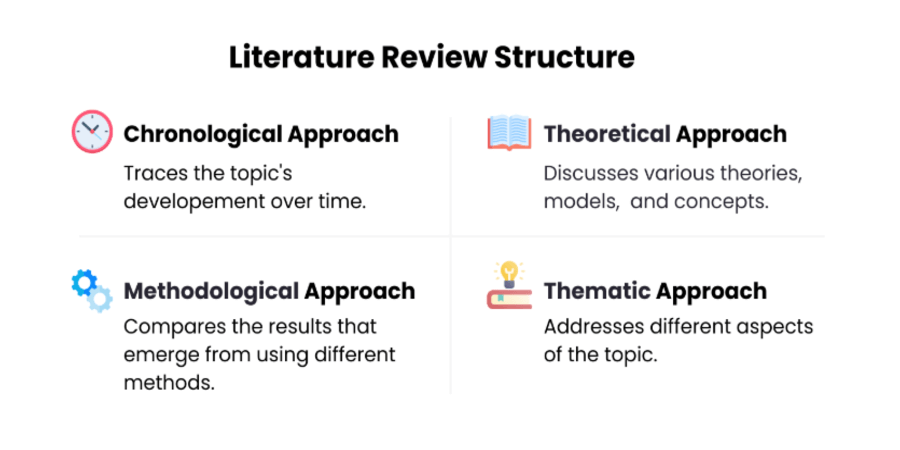
Chronological Approach
Tracing the reviewed works in succession, starting with the earliest available materials, is the easiest way to examine the specific topic. Be careful not to list the works in chronological order with their summaries. The purpose of such a review is to find out the key patterns, central debates, and turning points of the prevailing opinion at specific periods.
Here is a sample to make the approach clear. If the first available source dates 1995, and the most recent one was written in 2017, divide your analysis into decades: 1995 – 2000, 2001 – 2010, and 2010 – present.
The chronological approach can perfectly combine with thematic or methodological ones. In such a case, the timescale is divided not by decades but by periods characterized by a predominant methodology or preferred theme.
Thematic Approach
This method is organized around a particular issue, rather than time progression. If you have found recurring themes in the course of your reading, it is an excellent idea to focus the review on them. As a rule, the thematic approach requires an in-depth study of the available scientific literature. It also looks more substantial and time-consuming than the chronological one.
Here, the sections dwell upon different issues or various aspects of one topic. For example, an overview of psychology literature on nonverbal communication can be divided into the following parts: facial expressions, postures, eye contact, gestures, touch, etc.
Methodological Approach
Sometimes the results of findings are not as outstanding as the ways of obtaining those results. A review of research methods provides a profound scientific understanding of the subject field, notably the approaches to data collection, study, and systematization. It also provides an insight into how scientists went from isolated data to a concept, and from the concept to practical conclusions.
This form proves to be the most successful in the analysis of multidisciplinary works. You can list all the methods used and conclude on their efficiency. Alternatively, you can compare the qualitative and quantitative, empirical and theoretical, or any other incompatible methodology. The materials for analysis are the results obtained by such or another method.
Theoretical Approach
Very often, a literature review becomes the basis for a theoretical framework of a research paper. In this case, the theoretical approach is the most effective way to structure the report.
Wherever you can single out several theories on a single phenomenon, different models of a system, or diverging definitions of the same concept, the theoretical approach is the best choice. The purpose is to analyze the corpus of theory that has accumulated regarding an idea, opinion, or event. Usually, this form establishes the existing scientific knowledge gaps and finds out the outstanding research questions.
🗺️ Literature Review Outline: Mapping the Concepts
Wish to outline literature review papers correctly? First, try drawing a concept map for your outline! Create a graphic map with all the concepts and ideas you’ll want to include in the literature review outline. When you start writing, make sure that you’ve included everything you have on the map.
Well, now you’re ready to write the most fantastic outline for a literature review ever! So what are you waiting for? Go ahead and try writing your own outline using the template below – success is just around the corner!
📰 Literature Review Outline: Template
Feel free to use the literature review outline template below! Note that the template is organized thematically.
Example:
I. ISSUE #1
A. Its features
1. Positive features
a) Feature #1
b) Feature #2
2. Negative features
a) Feature #1
b) Feature #2
B. Its significance
1. Positive effects
a) Effect #1
b) Effect #2
2. Negative effects
a) Effect #1
b) Effect #2
II. ISSUE #2…
Check the literature review samples by the University of West Florida to get a clear idea on how to write this type of paper.
And now, it’s time for you to see an example of an outline for literature review writing!
👌 Literature Review Outline: Example
When creating your own review, consider the following literature review example:
Example:
Literature Review Outline: Postmodern Literature
- Introduction: postmodern literature
- Definition of the phenomenon
- The development of postmodern literature
- Seminal research studies on the issue
- Research studies on postmodern themes
- Research studies on postmodern techniques
- Research studies on postmodern perspectives
- Conclusion: promising ideas for research on postmodern literature
With this literature review outline example, you’ll surely handle even the most complicated literature review structure!
✍️ Literature Review Outline: Writing Tips
When you start writing a literature review, you should keep the following issues in mind:
- Use evidence to support your interpretation of available sources.
- Be selective. Limit your literature review to sources relevant to the topic of your research. You should select only the most important points in each source.
- Compare and contrast the views of different authors. Organize the material for your reader to show trends in the literature.
- Use quotes sparingly. Apply them only when you want to emphasize the author’s point and cannot rewrite it in your own words. Always focus on giving your own summary and interpretation of the literature, showing your original thinking and analysis.
- Paraphrase in your own words to explain authors’ ideas. Give references to other sources when you are writing, but start and end the paragraphs with your own ideas.
- Summarize and synthesize your literature review sources. Identify the main points in a concise manner for your readers. Evaluate your sources, consider their strengths and weaknesses, compare and contrast the results of the studies, and discuss the strength of the evidence.
- Look for gaps in the existing research. Think about what aspects of your literature review topic have not yet been explored.
- Be creative!
- Draft and redraft. Improve the quality of your literature review by editing and proofreading.
Literature Review Essay Topics
- Literature review: aspects of nursing in the emergency department.
- Review the literature that analyzes the specifics of evidence-based nursing practice.
- Write a literature review on the role of hepcidin in the human body.
- Analysis of challenges faced by small and medium businesses in South Africa: a literature review.
- Explore the literature that examines the interdependence between evidence and practice in healthcare.
- Review the studies examining how peritoneal dialysis influences patients’ mortality rate.
- Analyze the articles studying the connection between obesity and depression.
- Literature review the use of ecology in art.
- Discuss the academic literature examining the algorithms of speaking recognition techniques.
- Study the articles on the importance of environmental biology for preserving nature.
- Write a literature review on the role of digital signatures and cryptography.
- Examine whether the recent studies prove the connection between peritoneal dialysis and mortality rate.
- Literature analysis on a qualitative study in healthcare.
- Explore the scientific literature researching how to adjust and regulate the effect of autism spectrum disorder.
- Analyze the articles on the causes of chronic fatigue.
- Review the academic literature discussing the effect of the token economy on the behavior of students with autism.
- The causes and effects of pressure ulcers.
- >Literature review on the link between COVID-19 infection and eye diseases.
- Literature review on third culture kids.
- Study the articles reviewing the efficacy of contemporary pressure ulcer prevention methods.
- Discuss the recent scholarly studies examining the correlation between nursing ratios and cases of hospital-acquired infections.
- Write the literature review on the benefits and side effects of corticosteroids used for asthma treatment.
- Examine the pertinent scholarly articles researching the aspects of irritable bowel syndrome diagnostics.
- Analyze the academic literature on chronic pain management.
- Provide the synthesis of recent scholarly studies focused on ventilator-associated pneumonia.
- Review the literature on cholecystitis symptoms and treatment.
- Importance and specifics of evidence-based nursing implementation.
- Explore the recent studies on anemia of chronic diseases.
- Discuss the academic articles analyzing postoperative readmission rates.
- Literature review on the breakthroughs in treating Alzheimer’s disease.
- Examine the relevant literature on the benefits of Electronic Health Record systems.
- Analyze the role of pressure ulcer protocols in reducing the rates of hospital-acquired pressure ulcer cases.
- Write a literature review on the effectiveness of the most popular ways of patient fall prevention.
- Review the relevant scholarly articles discussing the role of interprofessional collaboration in healthcare.
- Examine the recent academic literature on childhood obesity issues.
- Review the literature on the Capstone’s PICOT question.
- Literature review of articles on cyber security of young children.
- Discuss the latest studies examining the connection between American football and the drop in public health rates.
- Explore the relevant scholarly articles studying the challenges of single African American parents.
- Can the implementation of special physical exercises improve the balance and stability of elderly patients?
- Effects of traumatic brain injury: a literature review.
- Analyze the academic literature discussing the course and outcomes of operation Jawbreaker.
- Write a literature review on the emergency room wait time and healthcare quality.
- Review the academic articles that examine the causes of substance abuse and the efficacy of modern treatment methods.
- Examine the recent scholarly studies researching the homelessness issue.
- Discuss the academic literature analyzing the concept of biodiversity.
- Research the archeological articles studying the ancient Roman roads.
- Analyze the literature examining the benefits and drawbacks of flipped classroom approach.
- Literature review on prevention of breast cancer.
- Review the scholarly articles studying the impact of the ZIP code on human health.
Writing a good literature review is not an easy task. It requires quite a lot of reading and researching. Check our 45 great tips on how to format and structure the literature review for more advice.
If you still have any problems in writing your literature review outline, ask for professional writing help online.




![Ultimate Report Writing Tips for Students: Best Ideas [Free]](https://custom-writing.org/blog/wp-content/uploads/2021/01/business-desk-with-keyboard-report-graph-284x153.jpg)




![Library Research Paper: Example & Writing Guide [2026]](https://custom-writing.org/blog/wp-content/uploads/2021/01/library-with-books-284x122.jpeg)
![Research Analysis Paper: How to Analyze a Research Article [2026]](https://custom-writing.org/blog/wp-content/uploads/2021/01/opened-book-library-table-284x153.jpg)

please I was asked to write a 3000-word essay Evaluating Approaches to Literature Searching and Literature Review in Educational Research. And I don’t know how write or go about it. Can someone please help me with an outline in writing this.
please someone should help
HI, how long would you suggest an undergraduate’s final year research paper should be? ( minimum in pages for both quanti and quali researches) and is 15 pages of literature review( double spacing okay?
It would probably be between 10 and 20 pages. But it all comes down to the specific topic and instructions given. Fifteen pages for a literature review sounds good, if it’s an independent type of assignment. However, if it’s part of the undergraduate’s final year research paper mentioned above, then fifteen pages is probably too much. But, again, it all depends on the instructions, topic, etc.
thankyouuuu!!!!!!! best one so far
useful blog
keep going
Very well explained!
Really appreciate the great information guide on writing. It’s outstanding and brilliant how the outline process is explained herewith. Thanks.
Thank you so much. This was so helpful, especially with your examples of an outline.
I am working on a literary review on a couple of articles having to do with college football players getting paid. I have started my intro with info about the college athletic industry and how it is controversial, but how do I introduce/transition into the articles and the actually literary review?
Try to go with the facts, and stick with them. It would work kind of well, Janeth.
Hi Janeth,
Thanks for stopping by. Try to write about features, positive and negative ones.
Cheers!