Nobody likes this part of the writing process. It seems that the assignment is complete, and you can do something else, but no. If the text quality is low, editing can take you as much time as the writing. Most high school and college students do not know that editing is just one of the three essential steps required for a successful essay. Revising, editing, and proofreading are the three stages that come after writing a text. None of them should be disregarded.
This Custom Writing article will help you learn how to revise and edit. Checklists for each step can be for peer- and self- editing. There is also much information to consider in the writing process to make proofreading easier.
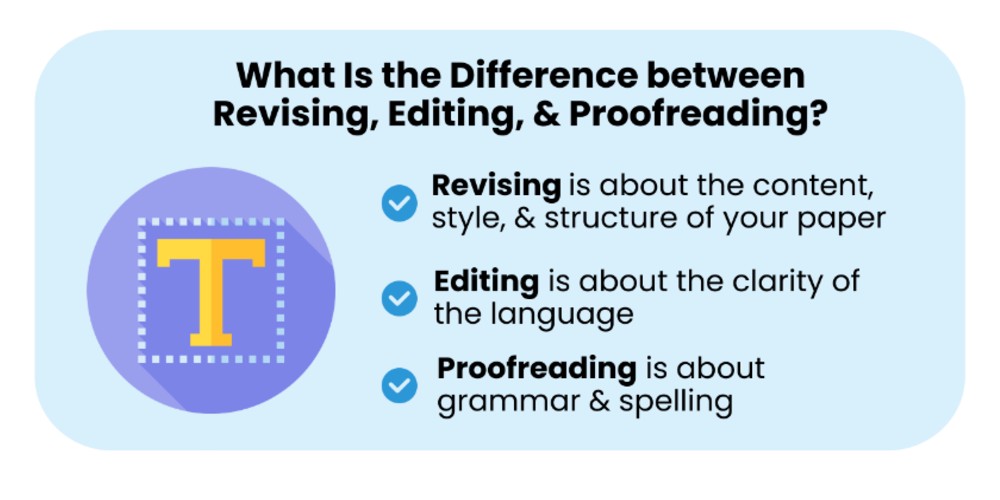
🤔 What Is the Difference between Revising, Editing, & Proofreading?
These are not synonyms. These are the stages of a revision, editing, and proofreading checklist. These stages will do both for a peer- and self-editing.
- Revising comes first. It is about the content, style, and structure of your paper. Re-read your essay for conflicting ideas, false conclusions, and out-of-place remarks. Check for any deviations from your thesis. Besides, check that every main body paragraph starts with a topic sentence.
- Then comes editing. It is about the clarity of the presentation. Are there any awkward or incoherent parts? Is your title attention-grabbing and relevant? Here you shall concentrate on the aesthetics, language, and meaning. Revise the meaning of words you are unsure about.
- Finish with proofreading. It is about grammar and spelling. Check each word and comma. Just make everything perfect.
Why Is Proofreading Important?
Proofreading is the final step of editing. It deals with spelling mistakes, inappropriate vocabulary, and formatting issues. It is especially critical in academic writing and business communication. After proofreading, a document is considered complete and ready for submission. That is why the final touch shall eliminate all the outstanding issues.
📑 Revising Checklist: Content & Structure
This section deals with revising your ideas and editing their form. The questions are structured by their subject. The purpose is to make sure that you’ve presented your thoughts in the most effective and concise manner.
Topic & genre
- Is the topic covered fully and clearly?
- Do you answer all of the questions in the essay instructions?
- Is your title exciting and related to the main idea of your paper?
- Does your paper adhere to the appropriate genre (e.g., memo, short story, analysis, narrative writing)?
- Does the title meet the genre requirements?
Structure
- Does your paper have an introduction, main body, and conclusion?
- Does your opening paragraph contain the necessary background information?
- Depending on the assignment, does your introduction end with a thesis statement that is clear and concise?
- Do you use appropriate paragraph breaks?
- Does each body paragraph contain a topic sentence and a conclusion?
Cohesion
- Do body paragraphs discuss ideas that support your thesis?
- Is each topic sentence supported with sufficient examples or details?
- Are there clear, logical, and sequential connections between your paragraphs?
- Do you use linking words and sentences to make easy transitions between your paragraphs?
- Is each paragraph sufficiently developed and coherent?
- Does your conclusion match and restate your thesis statement?
Style
- Do you write from a consistent point of view (that is, first, second, or third person)?
- Do you use the appropriate tense (past, present, or future)?
- Are your language and tone appropriate for your target audience?
🔍 Essay Editing Checklist: Language Use & Clarity
This section of the checklist ensures that you employ correct sentence structure and grammar in your paper. The purpose of this stage is to make your text easily readable and understandable. It’s a good idea to utilize a sentence reworder to eliminate the possible issues at this step.
Grammar
- Do all of your sentences contain a subject and a verb? Eliminate any sentence fragments.
- Do you use diverse grammatical structures?
- Have you eliminated all run-on sentences (complex sentences without proper punctuation)? E.g., “Everyone was sleepy, I wanted to go.”
- Do your verbs always agree with their respective subjects?
- Did you achieve the minimum possible use of passive voice?
- Did you delete any split infinitives in your sentences? E.g., She wanted to boldly pursue her purpose.
- Do you use “that” and “which” appropriately and accurately?
- Did you delete all faulty parallelisms? These are constructions that are used as homogenous parts of a sentence, but in fact, they are not. E.g., “He was smart, pleasant and did well at school.”
Punctuation
- Do you write sentences of different lengths and types?
- Are there any comma splices in your paper? If so, eliminate them.
- Do you have commas after time modifiers at the beginning of sentences?
- Does every sentence end with appropriate punctuation?
- Do you follow the rules for quotations?
Clarity
- Are your sentences concise?
- Have you deleted all unnecessary words?
- Do you avoid awkward and abrupt shifts?
- Have you simplified or removed any unnecessarily long and confusing sentences?
- Did you delete all redundancies (“totally perfect”), tautologies (“a comparative study discussing both aspects”), and vague words (“some,” “significant”)?
- Do you use clear antecedents for your pronouns?
🔤 Proofreading Checklist: Spelling & Formatting
This section examines your vocabulary, spelling, and formatting. These are the most common pitfalls in middle school writing. However, older students can also struggle with these issues.
Vocabulary
- Do you use any unnecessarily complex words to sound more sophisticated? If so, eliminate them.
- If you use special terms or foreign words, do you give their explanations?
- Is your vocabulary professional? Eliminate colloquialisms such as “basically,” “totally,” or “absolutely.”
- Do you use specific nouns?
- Do you avoid using abstract and unnecessarily general words and images?
- Are you aware of the connotations of all the words you use?
- Do you avoid unnecessary abbreviations?
- Do you avoid using clichés, buzz words, and overused expressions?
- Have you checked your paper for commonly confused words?
Spelling
- Do you use correct capitalization for titles, proper names, and sentence beginnings?
- Do you avoid common misspellings, such as you’re – your, there – their – they’re, then – than, and to – too – two?
- Is your paper free of any incorrect homophones and typos?
Formatting
- Do you include a reference page?
- Are the sources on the reference page ordered alphabetically?
- Does every source mentioned in the text appear on the reference page?
- Is every source from the reference page cited in the text at least once?
- Do you include a sufficient but not overwhelming number of citations and paraphrases throughout your paper?
- Do you support all specific data (such as figures and statistics) with a quote from a reputable source?
- Do you adhere to the formatting style requested by your instructor (e.g., MLA or APA)? Check the title page, margins, page numbers, paragraph indentation, running heads, and footnotes.
- Do you use a consistent and easy-to-read font such as Times New Roman or Arial?
In middle school, teachers start to approach our writing critically. It is human to make mistakes. But it is even more human to be able to find and correct them. Revising, editing, and proofreading are conventional stages for you to plan the post-writing corrections. But if you follow this plan, no mistake will persist.
🔗 References
- Editing and Proofreading – UNC Writing Center
- Revising, editing, and proofreading in academic writing | Simon Fraser University
- Steps for Revising Your Paper – Purdue OWL
- Revising the Draft | – Harvard College Writing Center
- Editing the Essay, Part One | – Harvard College Writing Center
- Proofreading – The Writing Center – UW–Madison
- Tips For Effective Proofreading – Writing Center
- Beginning Proofreading // Purdue Writing Lab
- Proofreading Your Paper | USC Libguides












Informative and useful!
Great tips! Thank you.
Thanks for the helpful post, this is what I need to edit my essays successfully. Once again, thanks for sharing these excellent guidelines!
I will bear in mind all the typical mistakes that students make when they edit their papers. Ten to avoid are enough to create an A+ essay or dissertation.