Understanding the structure of a literature review is essential for creating a coherent and impactful paper that summarizes and evaluates existing knowledge on a particular topic. The parts of a literature review include an introduction, body, and conclusion.
Here is what else you need to know to write a well-structured literature review:
- Include an overview of the current knowledge on the topic.
- Focus on the potential gaps in it.
- Outline and write all literature review parts.
Learn more about the literature review format with this guide by Custom-writing professionals! By understanding which parts to include, you can effectively highlight connections, contradictions, and trends in your review of related literature.
❓ What Is a Literature Review?
Whenever you are working on a significant paper, a literature review is unavoidable. It gives you an understanding of how your writing fits in the world of the existing knowledge on this topic. Some other aspects that it highlights are:
- Your knowledge of the context and the issue in general;
- Methodology and theories to use for your paper;
- Contrast and comparison of your work to other researches;
- Your work’s contribution to the field and how it might fill the gaps.
Sometimes, a literature review would be a separate assignment. Yet, in most cases, it’s a part of a more significant task, such as a research paper, thesis, or dissertation. So, you better know how to deal with it anyway. If you find yourself overwhelmed with gathering sources and synthesizing them, consider using our literature review writing service. We can help you craft a thorough and cohesive literature review and ensure it supports the general objectives of your project.
If it helps your understanding of this task, you can think of the process as building an upside-down triangle. You would narrow down the sources more and more each time until you hit the sweet spot! Look how easy it is to organize your literature review!
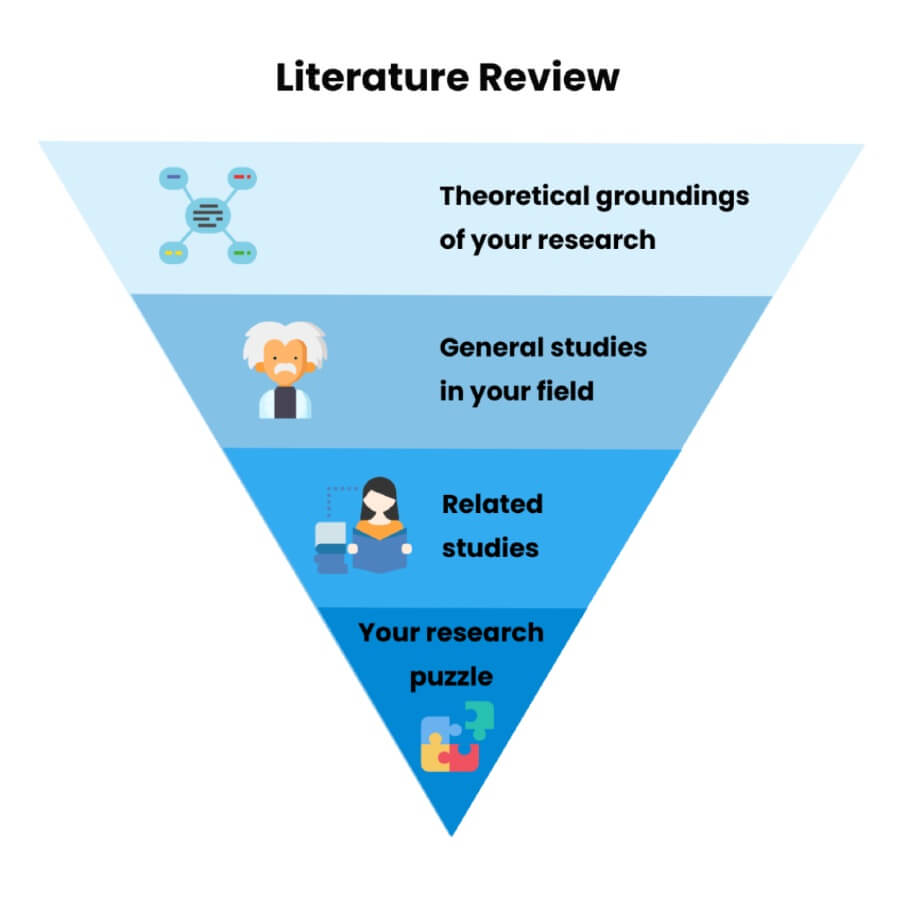
- Find all the relevant theories and foundational research that characterize your work.
- Now, look for studies that are related to your research.
- Narrow them down to studies that are similar to yours by the issues highlighted, strategies, and so on.
- From those, you can finally see your research gap!
Importance of Literature Review
So you might still be wondering about the importance of the literature review. As mentioned above, this type of writing allows you to build a strong base for your future research.
Besides, you can gain even more knowledge on the topic while going through all the previous studies! And you will show it off to the readers so that they have more confidence in your reliability! Moreover, it helps you identify which areas of the field that you chose need some improvement. This way, you know what gap to fill exactly and what issues have already been resolved by other researchers.
Annotated Bibliography vs. Literature Review
There is a slight difference between an annotated bibliography and a literature review. The first one can only analyze each source depending on its relevance to your topic, and it’s relatively brief. Meanwhile, a literature review is a complex examination of multiple sources and their relations. It contrasts and compares them together in detail.
How Long Should a Literature Review Be?
In case the length of the literature review is not mentioned in the requirements, there are a few hints to help you understand what to aim for. Generally speaking, one-fifth of the total size of your paper would be enough. However, if it’s a dissertation, the literature review might need to take up as much as twenty-five percent of your whole piece!
💡 Literature Review Topics
Looking for literature review topic ideas and picking the best one is not the step you can skip! Any research needs an issue to develop. The aim of your literature review is closely connected to the topic of your paper since you need to evaluate relevant sources. Choosing the problem, you are passionate about is the best way to go! Try brainstorming some ideas and pick at least three strong ones. After selecting one, check if there is enough material like articles and journals to work with. Narrow it down if it’s too general and put it in the form of a thesis statement.
📑 How to Organize a Literature Review?
So now that you know what you would like to include in your literature review, it’s time to organize it! There are several ways to do it. As you might know, all papers follow the universal scheme: introduction, main body, and conclusion. Let’s move on and discuss the strategies you can use for organizing your review.
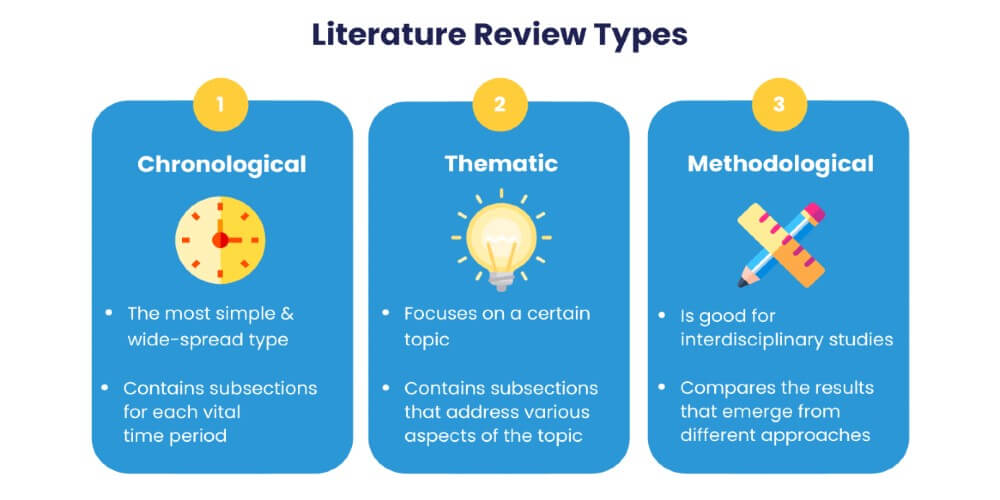
- Chronological Literature Review. It’s one of the most accessible options since you just follow the chosen topic’s development through time. Yet, you should be careful! Merely presenting the sources is not enough. There should be some analysis done. Look into what turning points and debates affected the field, and give your opinion about it.
- Thematic Literature Review. While doing research, you might have found some themes that keep recurring. You can dedicate a separate subsection of your literature review for each of them. Those are usually the keywords related to the topic you picked. For instance, while your literature review is about migrant health and inequalities, the main themes would be healthcare policy and cultural perspective.
- Methodological Literature Review. You might have chosen to collect the sources for your literature review from different fields. In that case, you noticed that they all use distinct research methods. It might be a good idea to compare and contrast the findings and conclusions that appear from various approaches. For instance, look into the differences between the results of qualitative and quantitative research.
How to Format a Literature Review?
A great literature review should have a flawless logical cohesiveness. It is vital to structure the paper properly. You can resort to the standard rules:
- a high-level overview of the topic in the introduction;
- several key points with supporting arguments in the body;
- a logical conclusion (connected with the intro).
⚙️ Parts of a Literature Review
It’s essential that you don’t mix your literature review structure and include the correct information in each part. There should be your topic and its significance mentioned, background theories, and a brief explanation of your methodology and outline in the introduction. You might as well talk about the gaps in research there. The main body needs to include the discussion of the sources you selected following the organizational strategy you chose. Finally, you would sum up all the key findings in conclusion. In this last part, you can also address the question of your research’s place in the existing knowledge.
Literature Review Introduction
When writing the introduction, you will be presenting the topic of your review to your audience. Keep in mind the tips below as you write.
Literature Review Body
This is the time to go into detail. Depending on how long your literature review is, you can divide your body into subsections. Do that in accordance with the type of literature review organization that you chose (thematic, chronological, or methodological).
Literature Review Conclusion
Finally, you need a conclusion that will tie up your review into a neat little package. In your conclusion, you should summarize your review’s findings, describe the common points between the sources, and justify your research proposal if you are making one. You may try and use a summary maker if you dobt that you’re going to nail it right away.
When writing your literature review conclusion, keep in mind the tips below.
🏁 Concluding Remarks
A well-written review of literature will be worth every bit of effort it took to write it. It will provide a quick but thorough overview of the literature you used presented in a way that will make your professor very pleased with your work.
Take the time to work on your review thoroughly. Ensure that it is good not only in terms of the content but also in terms of the formatting. Check out these articles for information on how to provide citations in APA, MLA, Chicago, and Harvard styles.
If you are still having trouble writing your review, then consider watching the following videos.
🔗 References
- Learn how to write a review of literature – UW-Madison Writing Center
- The Literature Review (USC Libguides)
- Introduction to literature reviews – Research & Learning Online
- Literature Review | UNSW Current Students
- Conduct a literature review | University of Arizona Libraries
- Graduate Writing Workshops: Literature Reviews // Purdue OWL
- Academic writing: What is a literature review? | SFU Library


![Library Research Paper: Example & Writing Guide [2026]](https://custom-writing.org/blog/wp-content/uploads/2021/01/library-with-books-284x122.jpeg)
![Research Analysis Paper: How to Analyze a Research Article [2026]](https://custom-writing.org/blog/wp-content/uploads/2021/01/opened-book-library-table-284x153.jpg)
![American Antiquity Style Guide: Citation Rules & Examples [2026]](https://custom-writing.org/blog/wp-content/uploads/2020/12/education-concept-books-laptop-library-284x153.jpg)







A sample of a “generic” review would be helpful. I am a visual learner and would like to see how it is typically formatted.
Definition, guidelines, tips for literature review writing are perfect! These concise but the most important tips helped with my literature review! God bless you!
Thanks! This post is going to help me greatly with literature review writing as it contains lots of sound guidances and tips. Thank you! Thank you! Thank you!